
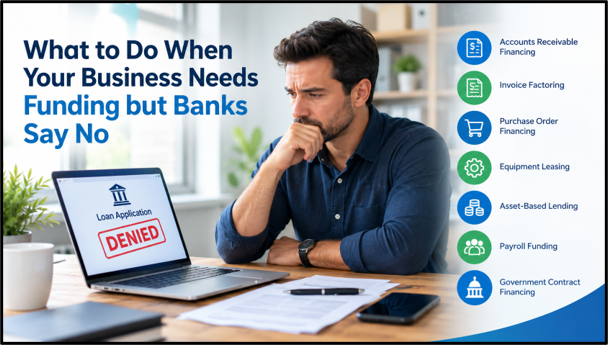
A bank’s decision to decline a loan application can create immediate pressure for a business. Payroll, supplier invoices, equipment purchases, or a newly awarded contract may still need attention, even when a traditional lender is unwilling to provide financing.
For some businesses, the next step is to look at how money is moving through the company. Are funds tied up in unpaid invoices?A large customer order. Does it require costs upfront? Could the equipment be financed instead of purchased outright? These questions can help you figure out which funding approach is right for the business. Capital Business Finance provides financing solutions to businesses nationwide. Their offerings include accounts receivable financing, invoice factoring, purchase order financing, equipment leasing, asset-based lending, payroll funding and government contract financing. The options each solve a different cash-flow problem, and the availability depends on the details of the business and transaction.
Understand what is driving the funding gap
Before applying for another product, define the immediate need. Estimate the amount required, when it is needed, what it will pay for, and how the business expects to cover the cost of financing.
It also helps to review why the bank declined the application. The decision may relate to credit history, time in business, existing debt, collateral, cash flow, or the lender’s underwriting criteria. Ask for the reason and check that the documents you supplied were complete and consistent. Updated financial statements, bank records, accounts receivable reports, contracts, and purchase orders can help explain the company’s current position.
A bank’s decision is one lender’s assessment under its own criteria. If the business has valuable invoices, eligible assets, or a confirmed order, another financing structure may be worth discussing.
When unpaid invoices are holding up cash flow
Businesses often deliver products or complete work before customers pay. That delay can make it difficult to pay suppliers, meet payroll, or accept new projects. Accounts receivable financing and invoice factoring are designed around eligible outstanding invoices.
With accounts receivable financing, invoices may be used as collateral for working capital. With factoring, a business may sell eligible invoices to a factor for an advance, then receive the remaining balance, less the agreed fee, after the customer pays. Capital Business Finance describes a process that verifies invoices before advancing funds, with the customer’s credit quality playing a role in the review.
The amount advanced, fees, payment handling, and other terms can vary. Businesses should ask how the arrangement works for their customers and what they will receive after fees are deducted.
When a confirmed order needs upfront funding
A sizeable order can be a growth opportunity, but fulfilling it may require money for materials, manufacturing, shipping, or other supplier costs before the customer pays. Purchase order financing may help eligible businesses cover certain costs associated with fulfilling a valid order.
Capital Business Finance describes overseeing and funding parts of the order fulfillment process. Once the order is delivered and invoiced, the financing may transition into an accounts receivable arrangement. This can connect funding to the order cycle, from fulfillment through the customer’s payment.
Before moving forward, confirm which costs are covered, what documentation is required, how suppliers are paid, and how the expected customer payment affects the full cost of financing.
When equipment or business assets may support funding
A large equipment purchase can put pressure on cash reserves. Equipment leasing may allow a business to obtain equipment while spreading payments over time. Capital Business Finance also describes options involving new equipment, refinancing existing equipment, and using unencumbered equipment to seek working capital. The terms depend on the equipment and the financing arrangement.
For businesses with eligible receivables, equipment, or inventory, asset-based lending may provide working capital secured by those assets. A facility may be structured around the value of the assets and could offer access to funds as needs arise. Because this type of financing involves collateral, understand which assets secure the facility, how availability is calculated, and what the agreement requires if cash flow changes.
When payroll or a government contract creates timing pressure
Payroll can become difficult when customer payments arrive weeks after work is completed. Capital Business Finance’s payroll funding service is linked to unpaid invoices, with the stated aim of helping businesses access funds for payroll and other operating needs while waiting for customers to pay. Ask how invoice eligibility, advance amounts, fees, and payment collection work before relying on a facility for recurring expenses.
Government contractors may face a different timing challenge: project expenses can begin before contract payments arrive. Capital Business Finance offers government contract financing for prime contractors and subcontractors working on state, federal, and municipal projects.The company describes how to tailor funding for task orders and other contract-related requirements. The terms of the contract and the paper work requirements are important. Talk about award, task order, payment process and project costs with a provider who understands government contracting.
Compare the full cost and structure
When comparing nationwide business loans or other funding, look beyond the amount offered. Review the total cost, fees, payment schedule, collateral, guarantees, customer payment requirements, and any effect on daily cash flow. Ask for the terms in writing and make sure projected revenue can support the arrangement.
Owners searching for Business Finance Solutions Nationwide should also confirm that the provider serves their state and industry, and ask which specific product fits the need. “Nationwide” describes service reach; it does not establish eligibility or guarantee approval.
For some businesses, alternative business financing tied to invoices, purchase orders, equipment, assets, or government contracts may be more relevant than a general-purpose loan. The right option depends on what is creating the funding gap and what resources the business can use to meet its obligations.
Make a funding decision that supports the business
A bank decline does not automatically mean the business has no options, but it is a good reason to review the numbers before applying again. Identify the need, gather current documents, compare financing structures, and understand the repayment or collection process before signing.
Capital Business Finance provides working capital solutions for a range of business scenarios including receivables, purchase orders, equipment, assets, payroll and government contracts. If you’ve had your business declined by a bank and are considering funding, contact Capital Business Finance to talk about your situation and see what options may be available. Terms, costs and approval subject to review.